Call us today!: (440) 610-2804
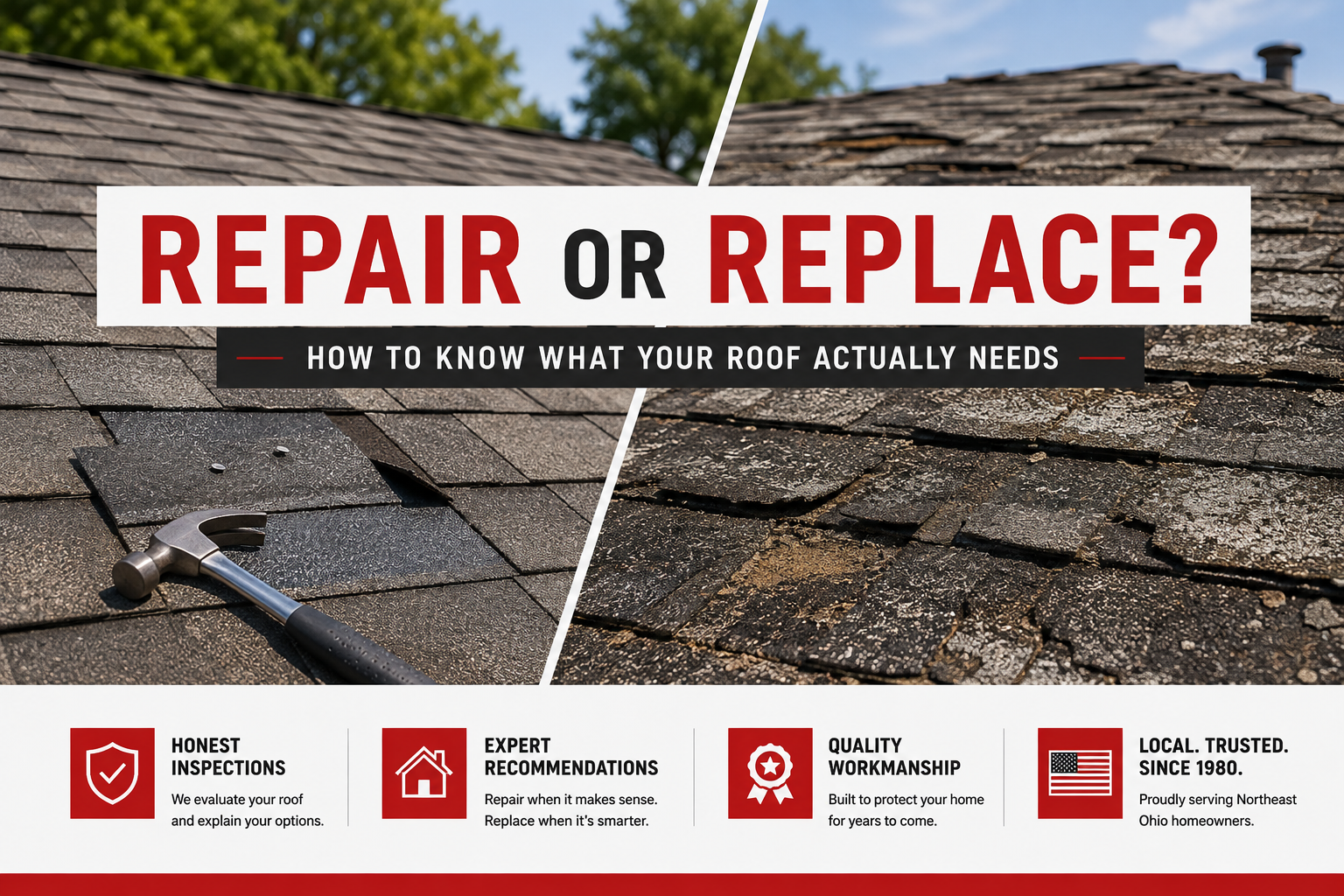
A damaged roof doesn’t automatically mean you need a new one.
That sounds obvious, but when homeowners see missing shingles, find water in the attic, or notice something that doesn’t look right after a storm, “Do I need a new roof?” is usually one of the first questions that comes to mind.
Sometimes the answer is yes.
Other times, a relatively small repair can give you several more years out of the roof.
The important part is figuring out which situation you actually have.
Start With the Age of the Roof
Age doesn’t tell us everything, but it gives us a good place to start.
Here in Ohio, asphalt roofs take a beating. Summer heat, winter cold, snow, wind, hail, and repeated freeze-and-thaw cycles all contribute to wear.
We’ve discussed this in more detail in our guide, How Long Does a Roof Really Last in Northeast Ohio?
If your roof is relatively young and otherwise in good condition, repairing an isolated problem usually makes more sense than replacing the entire roof.
Once an asphalt roof gets into the 10–15+ year range, however, we start looking much more closely at its overall condition.
That still doesn’t automatically mean replacement.
It simply means we need to ask whether spending money on repairs makes sense for a roof that’s already showing significant age.
When a Roof Repair Makes Sense
Roof repair is generally the better option when the problem is isolated.
Maybe a few shingles were damaged by wind.
Maybe flashing around a chimney has failed.
Maybe a small section was damaged by a falling branch.
If the rest of the roof is solid, tearing everything off would make very little sense.
A good roofer should be willing to tell you that.
Some common repair situations include:
- A few missing or damaged shingles
- Minor flashing problems
- Small localized leaks
- Damage confined to one area
- A relatively young roof with plenty of usable life remaining
We’ve also covered this question specifically in Can You Replace Just a Few Shingles? When a Repair Makes Sense—and When It Doesn’t.
When Replacement Starts Making More Sense
The decision changes when problems aren’t isolated anymore.
Imagine fixing one section this year, another next year, and another six months later.
At some point you’re no longer maintaining a good roof.
You’re continually putting money into a roof that’s reaching the end of its useful life.
We start seriously discussing replacement when we see things like widespread granule loss, curling or brittle shingles, recurring leaks, numerous previous repairs, sagging areas, or damage spread across multiple roof slopes.
Our 7 Warning Signs Your Roof May Need Replacement Soon guide goes deeper into those indicators.
What About a Roof Leak?
A leak doesn’t necessarily mean you need a new roof either.
Water has an annoying ability to travel.
Where you see a stain on the ceiling may not be directly underneath where water entered the roofing system.
The source could be a damaged shingle, flashing, a vent, chimney, valley, or another roof penetration.
That’s why finding the actual source matters before deciding what needs repaired.
We explain that process further in How to Address a Leak in Your Roof.
Storm Damage Changes the Conversation
Storm damage is a little different because a roof can appear perfectly fine from the ground while still having legitimate damage.
Hail can remove protective granules or damage the shingle mat. Wind can loosen shingles without completely removing them.
That’s one reason we recommend having the roof inspected after a significant storm rather than waiting for water to come through the ceiling.
A roof does not have to leak to be damaged.
And if you’re not sure what hail damage actually looks like, see our guide How to Spot Hail Damage on Your Roof: An Ohio Homeowner’s Guide.
Repair Cost vs. Remaining Roof Life
This is one of the biggest factors homeowners should consider.
Suppose a repair costs $1,500.
If that repair restores a relatively young roof that could reasonably last another decade, that’s probably money well spent.
If you’re putting $1,500 into a heavily worn roof that may need replaced next year anyway, that’s a different conversation.
The cheapest decision today isn’t always the least expensive decision over the next several years.
We try to look at both.
A Professional Inspection Should Give You Options
This is where the inspection matters.
A roofing inspection shouldn’t simply end with:
“You need a new roof.”
You should understand why.
At Jarrell Roofing, we’re looking at the condition of the shingles, flashing, penetrations, valleys, gutters, storm damage, previous repairs, and the overall roofing system.
Whenever possible, photos help show exactly what we’re seeing.
If the roof can reasonably be repaired, we’ll tell you.
If replacement makes more financial sense, we’ll explain why.
And sometimes the answer is simply:
Your roof looks fine. Keep an eye on it and check it again later.
That’s a perfectly good outcome from an inspection.
The Bottom Line
There isn’t a magic rule that says a roof with one leak needs replaced or a 15-year-old roof is automatically finished.
The right answer depends on the age, condition, extent of the damage, repair history, and expected remaining life of that particular roof.
If you’re trying to decide whether repairing or replacing your roof makes more sense, Jarrell Roofing can inspect it and show you what we’re seeing.
Contact Jarrell Roofing to schedule a free roof inspection with photo documentation.